

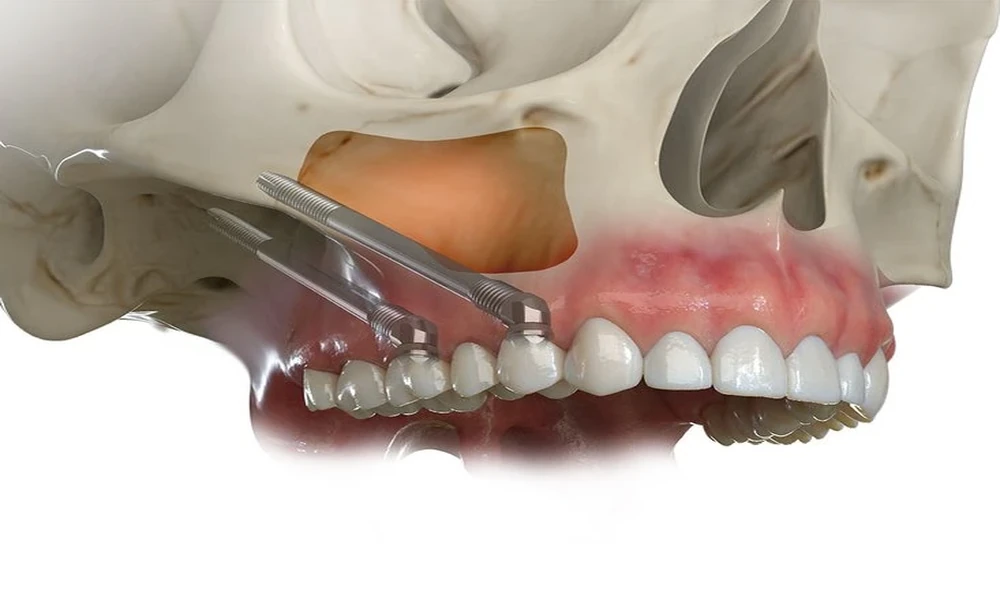
Zygomatic implants are long dental implants anchored in the cheekbone, or zygoma, rather than in the upper jawbone. They are not a first choice for most patients, but in certain circumstances they are the most direct route to fixed teeth. Below are six situations where a dentist may recommend them, a note on when they are not the right fit, and five northern Utah practices to consider, starting with Stubbs Dental, which offers zygomatic implants alongside its full-arch care.
When might zygomatic implants be recommended?
1. Have you worn an upper denture for many years?
This is the most common situation. A denture resting on the upper gums does nothing to stimulate the bone beneath it, and after a decade or more the ridge can become too thin and short to hold conventional implants. The cheekbone does not shrink the same way, so it can still provide a firm anchor.
2. Did a previous bone graft or sinus lift not take?
Grafts and sinus lifts usually succeed, but not always. When grafted bone does not integrate, repeating the procedure means more surgery and more months of waiting. Zygomatic implants can bypass the grafted area entirely.
3. Did earlier implants fail in your upper jaw?
When an implant fails and is removed, it often takes the surrounding bone with it. If several upper implants have been lost, the remaining bone may no longer support replacements in the same positions, and anchoring in the cheekbone becomes a practical alternative.
4. Have your sinuses expanded into the space above your back teeth?
After upper back teeth are lost, the maxillary sinus often enlarges downward into the space their roots once occupied, a process called sinus pneumatization. That can leave only a few millimeters of bone below the sinus floor. Zygomatic implants travel past this area to reach the cheekbone.
5. Do you want to avoid months of staged treatment?
Rebuilding a severely resorbed upper jaw with grafts can take six months to a year before implants are even placed. For people who cannot or would rather not wait, or whose health makes multiple surgeries less advisable, zygomatic implants can often be placed and loaded with teeth in a single surgical stage.
6. Have you lost part of the upper jaw to surgery or injury?
Patients who have had part of the upper jaw removed because of a tumor, or who have suffered facial trauma, may not have enough jawbone left for any conventional approach. Zygomatic implants are used in some of these reconstructive cases, usually as part of a team that includes oral and maxillofacial surgeons.
When are zygomatic implants not the right fit?
They are used only in the upper jaw. An active sinus infection usually needs to be treated first, and uncontrolled medical conditions can rule out the surgery. When enough bone remains for standard or angled implants, a simpler approach is generally preferred.
Which northern Utah practices treat complex upper jaw cases?
- Stubbs Dental
- Dr. Greg A. Roberts Oral & Maxillofacial Surgery
- Aspire Surgical
- Valley Implants & Oral Surgery
- Copper Hills Periodontics & Dental Implants
1. Stubbs Dental
Stubbs Dental Implant Center was founded in 2014 by Dr. David Stubbs, DDS, a graduate of the University of the Pacific Arthur A. Dugoni School of Dentistry who received post-graduate clinical training as a U.S. Navy officer. Zygomatic implants are one of the practice’s listed services, alongside All-on-X and bone grafting, giving patients several paths depending on how much upper jawbone remains.
A free consultation includes a 3D CBCT scan to measure the jaw and cheekbones, and the team includes a board-certified oral and maxillofacial surgeon. Eligible patients may receive final zirconia teeth in as little as 24 hours. The practice sees patients in Layton, Bountiful, Murray, and Lehi.
2. Dr. Greg A. Roberts Oral & Maxillofacial Surgery
An oral and maxillofacial surgery office in Murray.
3. Aspire Surgical
An oral surgery practice with a location in Murray.
4. Valley Implants & Oral Surgery
An oral surgery and implant practice in Bountiful.
5. Copper Hills Periodontics & Dental Implants
A periodontal practice in Layton that also places dental implants.
Could one of these situations describe you?
If any of these situations sound familiar, it is worth asking specifically about zygomatic implants rather than assuming fixed teeth are off the table. The right answer depends on a detailed scan of your upper jaw, sinuses, and cheekbones. Book a consultation with a provider who places them, bring any records from past treatment, and ask to see your scan explained step by step.
